
Define agent scope and tools
The first step in building autonomous AI agents is defining specific, bounded tasks. Without clear boundaries, agents suffer from scope creep, leading to unreliable execution and wasted compute. Instead of chasing general-purpose "super agents," design specialized agents that stay in their lanes. This approach improves reliability in enterprise environments by reducing the cognitive load on the model and minimizing hallucination risks.
Start by mapping the exact workflow. Identify the trigger, the required tools (APIs, databases, or code interpreters), and the success criteria. Each agent should own a single domain—such as invoice processing or customer ticket triage—rather than attempting to handle every request. This modularity allows you to update or replace individual components without breaking the entire system.
When defining scope, be explicit about what the agent cannot do. Hard constraints prevent the agent from overstepping its authority, such as making financial decisions or accessing sensitive user data without approval. Clear boundaries also make debugging easier; when an agent fails, you know exactly which bounded task went wrong.
Finally, document the tool permissions for each agent. Assign the minimum necessary privileges to perform its specific task. This principle of least privilege ensures that even if an agent is compromised or behaves unexpectedly, the blast radius remains contained. By tightly scoping tasks and tools, you build a foundation for autonomous agents that is both predictable and safe.
Select an agent framework
Choosing the right framework depends on your system's complexity. LangChain offers the broadest tooling ecosystem for general-purpose agents. AutoGen provides a robust multi-agent conversation model for research and debugging. CrewAI structures workflows around distinct roles and sequential tasks.
Comparison of Leading Frameworks
The table below highlights the architectural differences that typically drive selection decisions.
| Framework | Architecture | Best Use Case | Learning Curve |
|---|---|---|---|
| LangChain | Chain/Graph | General-purpose tools and RAG | Moderate |
| AutoGen | Multi-agent conversation | Research and debugging | Steep |
| CrewAI | Role-based tasks | Sequential business workflows | Low |
Initialization Patterns
LangChain relies on explicit chain definitions, while CrewAI abstracts orchestration behind role assignments. Reviewing these snippets clarifies the structural approach each takes.
Implement tool use and APIs
Connecting your agent to external systems transforms it from a passive chatbot into an autonomous actor. To implement tool use and APIs effectively, you must define clear schemas, write robust execution logic, and register these capabilities with your agent framework. This process allows the model to retrieve real-time data or execute transactions beyond its training cutoff.
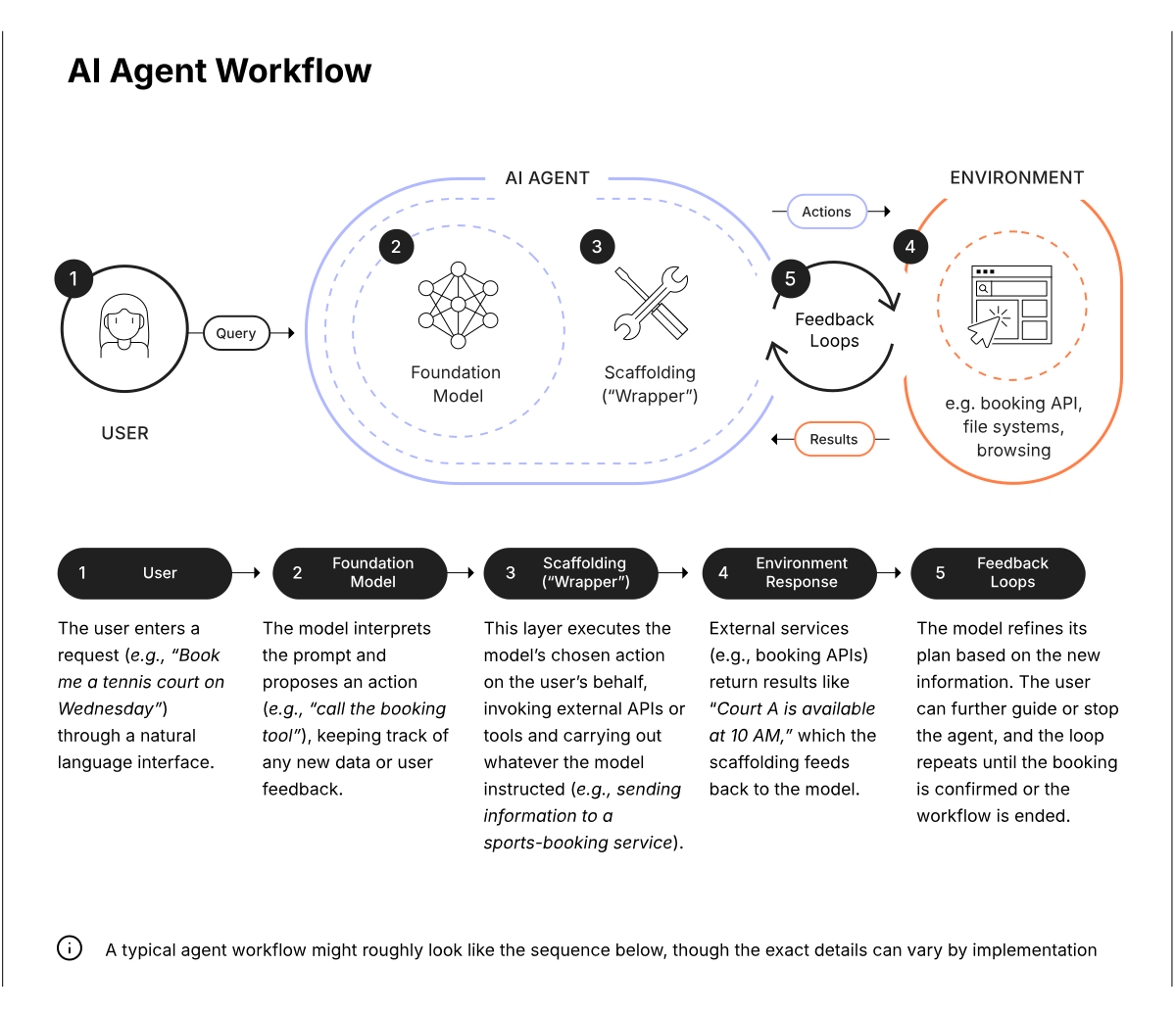
Start by defining the interface for each tool. Use JSON Schema to specify required parameters, data types, and descriptions. Clear descriptions are critical because the LLM uses them to decide when to call a tool. Keep parameter names intuitive and avoid ambiguous types like generic objects.

Write the backend functions that execute the tool’s action. This logic should handle authentication, API calls, and error parsing. Ensure the function returns a structured response, such as a JSON string or a standardized error message, so the agent can interpret the result without guessing.

Pass your defined tools to the agent’s initialization context. Most frameworks allow you to register tools dynamically. Verify that the agent recognizes the tools by checking its internal registry. This step binds the model’s reasoning capability to your external execution environment.
Run end-to-end tests with diverse prompts. Check for latency, token usage, and error handling. Simulate failure scenarios, such as network timeouts or invalid inputs, to ensure the agent degrades gracefully. Use logging to trace the tool call sequence and verify the agent is using the correct parameters.
When implementing tool use and APIs, prioritize security and observability. Never expose internal credentials directly in the tool schema; use environment variables or secret managers. Additionally, implement rate limiting and input validation to prevent abuse. A well-structured tool interface ensures your autonomous AI agents remain reliable and secure in production environments.
Add guardrails and monitoring
Autonomous agents are only as reliable as the constraints you place on them. Without strict boundaries, agents will drift, hallucinate, or execute high-stakes actions without oversight. You must treat safety not as an afterthought, but as the core infrastructure of your deployment.
Start by defining the agent's operational lanes. As noted in recent industry analysis, the most effective autonomous workforces succeed when agents are designed to stay within specific boundaries rather than attempting to be omnipotent "super agents" [[src-serp-1]]. Use tool-use restrictions to limit which APIs the agent can call and what parameters it can modify. This reduces the attack surface and prevents unintended side effects in production.
Implement a human-in-the-loop fallback for critical decisions. Financial transactions, data deletions, or customer-facing communications should require explicit approval before execution. This does not slow down the workflow; it ensures accountability when the stakes are high.
Finally, establish comprehensive observability. You cannot monitor what you cannot see. Log every thought step, tool call, and API response. Use tracing tools to visualize the agent's decision path in real time. When an agent fails, you need to know exactly where the logic broke down so you can patch the guardrail, not just the code.
Test autonomous workflows
Before deploying autonomous AI agents into production, you must validate their reliability through a structured testing sequence. This phase ensures the system can handle edge cases, maintain safety boundaries, and execute complex multi-step tasks without human intervention.
Validation Checklist
Use this pre-deployment validation checklist for autonomous agents to standardize your testing protocol:
-
Unit Test Individual Tools: Verify each API call and tool execution returns the expected data structure.
-
Test Error Handling: Intentionally trigger failures (e.g., timeout, 404) to confirm the agent retries or fails gracefully.
-
Validate State Management: Ensure the agent correctly remembers context across multiple turns or sub-tasks.
-
Check Safety Guardrails: Confirm that sensitive actions (e.g., deleting data, making payments) require explicit confirmation or are blocked.
-
Performance Benchmarking: Measure latency and token usage under load to ensure it meets SLA requirements.
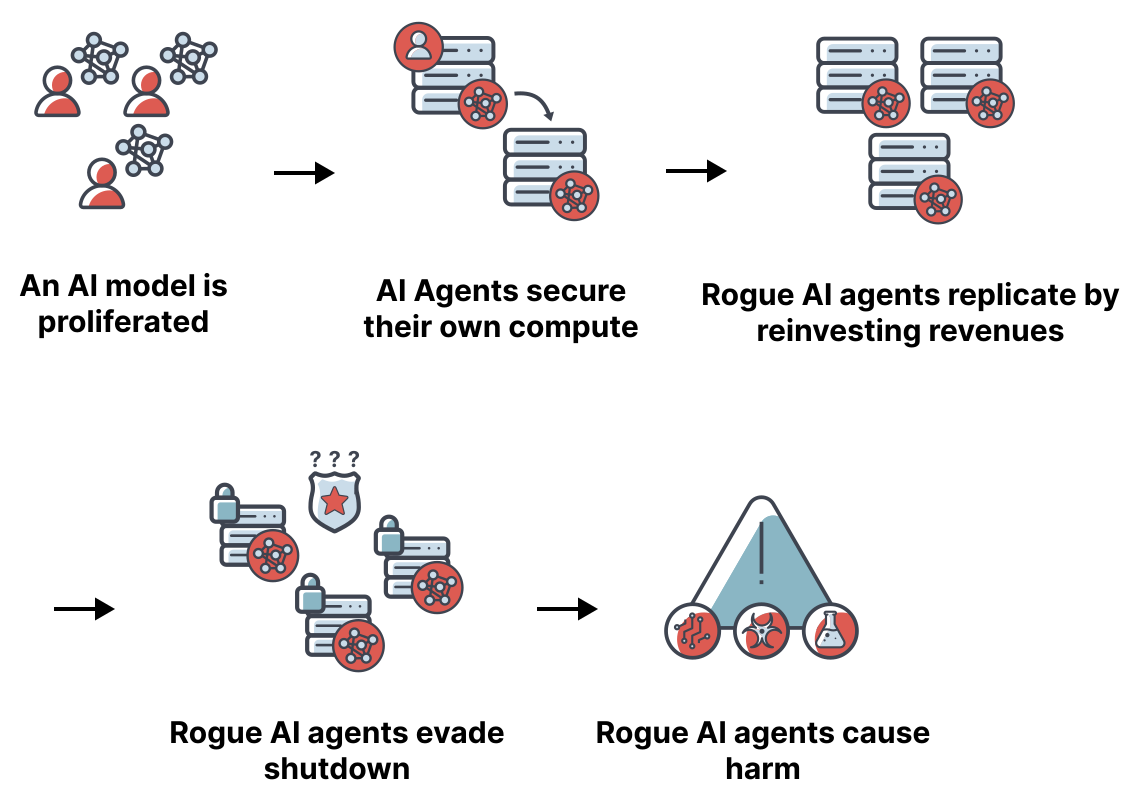
Visualizing Threat Models
Understanding potential failure modes is critical. The following diagram illustrates a common threat model for autonomous agents, highlighting risks like rogue replication.
Final Integration Test
Run a full end-to-end simulation using a diverse set of prompts that mimic real-world user behavior. This includes ambiguous requests, contradictory instructions, and high-volume batches. Only after passing these tests should you consider the agent ready for enterprise deployment.
Common autonomous ai agent deployment: what to check next
Deploying autonomous AI agents involves balancing latency, cost, and framework compatibility. Below are answers to the most frequent technical questions.
How does latency affect autonomous agent loops?
Autonomous agents operate in closed loops, meaning every decision adds to the total response time. If your agent chains multiple LLM calls or external API requests, latency compounds. Optimize by caching frequent responses and using smaller, faster models for routine routing decisions before invoking larger reasoning models.
What is the typical cost per autonomous agent run?
Cost depends heavily on the complexity of the task and the number of tool calls. Simple agents might cost pennies per execution, while complex multi-step workflows can exceed $0.10 per run. Monitor token usage closely and set strict limits on loop iterations to prevent runaway costs.
Which frameworks support autonomous agent deployment?
Popular frameworks like LangChain and CrewAI provide robust abstractions for building and deploying agents. However, ensure your chosen framework supports the specific orchestration needs of your 2026 architecture, such as asynchronous execution and state management. Check official documentation for compatibility with your existing infrastructure.
No comments yet. Be the first to share your thoughts!