
Define agent scope and guardrails
Establish boundary conditions before writing code. In 2026, agentic AI failure stems from overreach, not capability. Agents lacking strict legal and operational limits breach compliance frameworks, causing data leaks or unauthorized actions. Governance must be baked into the architecture from day one.
Define the agent’s specific lane. Gartner identifies agentic AI as a key 2026 trend, predicting 33% enterprise adoption by 2028. This relies on avoiding "super agents" that attempt everything. Design narrow scopes aligned with specific workflows.
Map permissions against regulatory requirements. Set hard limits on data access, transaction volumes, and external communications. Agents should never have blanket database access or execute high-stakes decisions without oversight. Constraining the environment reduces the attack surface and ensures compliance.
Collaborate across legal, security, and engineering. Legal defines "must-nots," security defines "can-never-access," and engineering implements these as immutable code-level guardrails. Once boundaries are set, select tools that respect these limits.
Select the orchestration framework
The framework is the central nervous system for autonomous agents. It dictates coordination, context sharing, and error recovery. For enterprise deployments, the orchestration layer determines stability under load.
Prioritize frameworks with native self-healing logic and robust security boundaries. The following comparison highlights three primary contenders based on autonomy levels, error recovery mechanisms, and enterprise-grade security features.
| Framework | Autonomy Level | Error Recovery | Enterprise Security |
|---|---|---|---|
| LangGraph | High (Cyclic) | State checkpointing | RBAC, Audit logs |
| AutoGen | Medium (Conversational) | Manual fallback | API key management |
| CrewAI | High (Role-based) | Agent retry loops | Role-based access |
LangGraph offers high control via cyclic graphs, allowing agents to revisit states for auditing. AutoGen uses conversational patterns, simpler but lacking state management for complex tasks. CrewAI uses role-based approaches, requiring careful data isolation configuration.
For high-stakes environments, trace every action to a state change. Frameworks enforcing strict role-based access control (RBAC) and detailed audit logs provide necessary transparency. Avoid black-box frameworks; you need visibility to debug failures and satisfy legal requirements.
Implement self-healing error handling
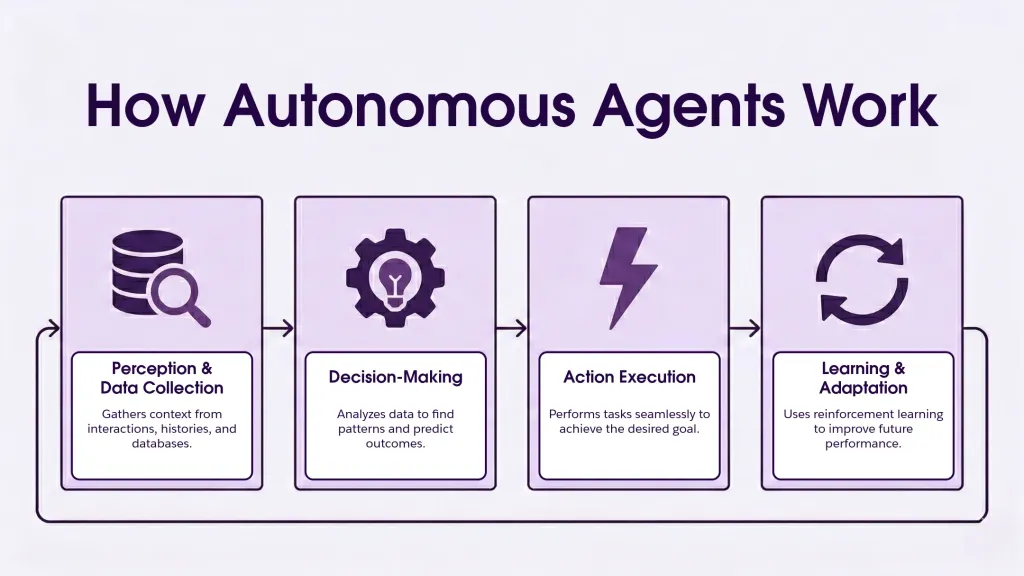
Autonomous agents must recover from failures without human intervention to maintain compliance. Self-healing error handling creates a closed loop: detect anomaly, diagnose root cause, execute corrective action within safety boundaries.
This reduces downtime and prevents minor glitches from becoming regulatory violations. By configuring agents to stay in their lanes, recovery actions do not violate broader system constraints.

Set explicit metrics for failure. Define numerical thresholds for latency, accuracy, or data consistency. For example, trigger healing if response time exceeds 200ms or confidence drops below 0.85. This precision prevents fixing minor deviations.
Create a lookup table linking error codes to approved recovery actions. A "404 Not Found" might query a backup source; a "403 Forbidden" should halt and request human authorization. This mapping ensures every recovery step is compliant and auditable.

Implement retry mechanisms with exponential delay increases to prevent system overload during transient outages. Limit maximum retries (e.g., three attempts) to avoid infinite loops. After final failure, log context and escalate to human operators.

Before applying a fix, run a validation step. Check if the correction aligns with compliance rules. For instance, verify new data meets regulatory format requirements before overwriting fields. This layer acts as a final safety gate.
These steps create a resilient system. The agent remains within its lane, correcting only what it is designed to fix, while escalating issues outside its scope.
Validate security and compliance
Prove regulatory standards for data privacy and auditability before handing control to an autonomous agent. Treating compliance as a final checkpoint causes deployment failure. Outline specific validation steps to ensure legal and security boundaries.
1. Verify data privacy boundaries
Autonomous agents require sensitive data access. Validate alignment with GDPR or CCPA. Implement strict data minimization: access only specific data points necessary for the immediate task, not the entire database.
Use technical controls like role-based access control (RBAC) and data masking. Encrypt personally identifiable information (PII) in transit and at rest. Verify third-party API connections adhere to organizational privacy standards.
2. Establish comprehensive audit trails
Regulators need to understand agent decisions. Implement logging mechanisms capturing inputs, reasoning, and outputs. Logs must be immutable and stored separately from the operational environment.
Include timestamps, user identifiers, and model versions. This transparency is critical for debugging and demonstrating compliance. Without clear records, you cannot prove the agent acted within its authorized scope.
3. Conduct pre-deployment security testing
Perform rigorous security testing before going live. Include penetration testing to simulate attacks and validate defenses against prompt injection or data exfiltration. Use automated scanners for code vulnerabilities.
Validate graceful handling of unexpected inputs. Test edge cases where the agent might make high-risk decisions. Ensure human oversight mechanisms can override the agent if it behaves unexpectedly.
4. Final compliance checklist
Use this checklist before deployment:
-
Data privacy impact assessment completed and documented.
-
Role-based access controls configured and tested.
-
Audit logging enabled with immutable storage.
-
Penetration testing results reviewed and vulnerabilities patched.
-
Human override mechanisms verified and accessible.
-
Regulatory compliance documentation updated and signed off.
Monitor and refine agent performance
Autonomous agents drift. Without active oversight, compliance gaps and performance decay accumulate silently. Treat monitoring as a continuous feedback loop to catch deviations early.
1. Establish baseline metrics
Define "good" for each agent. Track latency, error rates, and compliance flags. Use baselines to detect anomalies. Alert if response times spike or hallucination rates increase.
2. Implement real-time auditing
Log every interaction. Use structured logging for inputs, outputs, and decision paths. This data is essential for post-incident analysis and audits. Ensure logs are immutable and stored securely.
3. Conduct periodic reviews
Schedule monthly performance reviews. Analyze error trends and user feedback. Adjust prompts, guardrails, or model configurations based on findings. This iterative refinement keeps agents aligned with evolving needs.
4. Test for edge cases
Regularly run synthetic tests to expose weaknesses. Simulate adversarial inputs, unusual workflows, or compliance boundary conditions. Fix vulnerabilities before production exploitation.
5. Update documentation
Keep runbooks and compliance records current. Document behavior changes, new risks, and mitigation strategies. This ensures transparency and accountability for stakeholders and regulators.
Common deployment pitfalls
Even with strong guardrails, autonomous agents fail when they overreach. The most frequent error is designing "super agents" that manage entire workflows across multiple systems. This creates fragile dependencies and increases cascading error risks. Design specialized agents that stay in their lanes within a broader orchestration layer.
Another critical mistake is deploying agents without clear human escalation paths. In high-stakes environments, agents must know when to stop and hand off control. Without explicit boundaries, agents may proceed with actions requiring judgment, leading to compliance violations. Always define "stop and ask" triggers before deployment.
Neglecting edge-case testing is a common oversight. Agents often perform well in standard scenarios but fail with unexpected data formats or outages. Rigorous stress testing ensures reliability when it matters most.
No comments yet. Be the first to share your thoughts!