
Define the agent scope
Start by identifying a single, high-friction workflow that can be fully automated. In 2026, the industry consensus has shifted away from building general-purpose "super agents" that attempt to handle broad corporate functions. Instead, successful implementations rely on specialized, narrow-scope agents designed to stay in their lanes. This approach minimizes context drift and prevents the error propagation that often derails broader autonomous systems.
When defining the scope, limit the agent to one specific domain, such as processing vendor invoices or managing customer support tickets for a single product line. This constraint allows the agent to leverage precise internal data and knowledge bases without needing to handle the ambiguity of cross-departmental tasks. By keeping the scope narrow, you ensure the agent operates on "ground truth" data with high accuracy, rather than guessing at context it was not trained to understand.
Treat the agent as a specialized worker rather than a general assistant. This mental model helps stakeholders set realistic expectations for performance and error handling. Once the scope is locked, you can proceed to define the specific inputs, outputs, and decision boundaries that will govern the agent's actions.
Connect secure data sources
Autonomous AI agents must operate on your organization’s "ground truth" rather than general web data. Without this grounding, agents risk hallucinating facts or violating compliance standards. In 2026, the primary role of human supervisors is managing specialized agents that are strictly limited to internal data, customer history, and verified knowledge bases.
1. Identify and catalog internal data silos
Before connecting any systems, map where your critical data lives. This typically includes CRM platforms like Salesforce, ERP systems, and internal document repositories. You need to distinguish between static reference data (policies, manuals) and dynamic operational data (customer records, inventory levels). This inventory determines the scope of the agent’s access and helps you apply the principle of least privilege.
2. Establish read-only API connections
Security is paramount when connecting agents to sensitive systems. Configure read-only API connections to your identified data sources. This ensures the agent can retrieve necessary context to answer queries or perform checks without risking accidental modification of your core records. Use service accounts with scoped permissions to limit exposure. Official documentation for your specific CRM or ERP provider should guide the authentication setup.
3. Implement vector indexing for retrieval
Raw data is difficult for LLMs to parse efficiently. Convert your unstructured documents and structured records into vector embeddings using a dedicated vector database. This enables semantic search, allowing the agent to find relevant information based on meaning rather than just keywords. Implement a retrieval-augmented generation (RAG) pipeline to ensure the agent references these indexed vectors before formulating a response, significantly reducing hallucination risks.
Set operational guardrails
Autonomous agents are capable of executing complex workflows, but they must operate within strict boundaries to prevent costly errors. The 2026 shift toward agentic AI requires a transition from experimental chatbots to specialized agents that stay in their designated lanes. To achieve this, you must define precise permission limits, financial caps, and mandatory human-in-the-loop checkpoints before deployment.
Define permission scopes
Restrict agent access to only the data and systems necessary for their specific task. An agent designed to process invoices should not have write access to customer relationship management (CRM) records or administrative settings. This principle of least privilege ensures that if an agent encounters an unexpected scenario, its ability to cause harm is contained.
Set financial caps
Implement hard limits on transaction values. For agents handling payments or procurement, configure system-level caps that prevent any single transaction from exceeding a predefined threshold. If an agent detects a request above this limit, it must automatically pause and flag the action for review rather than attempting to justify the exception.
Configure human-in-the-loop checkpoints
Critical decisions require human oversight. Identify high-stakes actions—such as terminating a contract, sharing sensitive personal data, or modifying core infrastructure—and configure the agent to stop and request approval. This checkpoint ensures that human judgment remains the final authority on matters with significant legal or reputational risk.
Monitor and adjust
Guardrails are not static. As agents encounter new edge cases, review their logs to identify where permissions were too loose or too tight. Adjust these settings iteratively, balancing operational efficiency with safety. Regular audits ensure that the agent’s behavior remains aligned with your organization’s evolving risk tolerance and regulatory requirements.
Test with controlled scenarios
Before deploying autonomous AI agents to production, you must validate their behavior against edge cases and failure modes. In 2026, as agents shift from passive responders to active executors, a single hallucination or logic error can trigger costly operational disruptions. Testing is not a final checkpoint; it is the primary mechanism for ensuring reliability.
1. Define failure boundaries and edge cases
Identify the specific actions your agent is authorized to take, then deliberately attempt to break those boundaries. This involves feeding the agent inputs that are ambiguous, contradictory, or outside its training data. The goal is to observe whether the agent halts safely or attempts to improvise. For example, if an agent is designed to process refunds, test it with negative amounts, duplicate transaction IDs, and incomplete customer records. Document every instance where the agent deviates from expected behavior.
2. Verify error recovery and fallback protocols
Autonomous agents must handle failures gracefully. When an external API fails or a data source is unavailable, the agent should trigger a predefined fallback protocol rather than looping indefinitely or crashing. Test these recovery paths by simulating network outages, rate limits, and malformed responses. Ensure the agent logs the error accurately and notifies human supervisors when intervention is required. This step confirms that the agent’s "ground truth" constraints remain intact even under stress.
3. Benchmark performance under load
Validate the agent’s speed and accuracy as request volume increases. Autonomous agents often operate in real-time, so latency can become a critical failure point. Run controlled simulations that mimic peak traffic conditions. Measure the time between task initiation and completion, as well as the rate of successful executions versus retries. If the agent begins to degrade in accuracy or speed under load, you must optimize its resource allocation or simplify its decision tree before deployment.

Feed ambiguous or out-of-scope inputs to the agent. Document every deviation from expected behavior to establish a baseline for safety constraints.
Simulate API failures and network outages. Confirm the agent triggers fallback protocols and logs errors accurately without looping or crashing.
Run load simulations to measure latency and accuracy under peak traffic. Optimize resource allocation if performance degrades.
Monitor and refine performance
Autonomous AI agents are no longer experimental prototypes; they are operational assets that require active supervision. As 2026 marks the shift from testing to deployment, your role evolves from builder to supervisor, ensuring these systems act on your organization’s ground truth rather than hallucinating decisions.
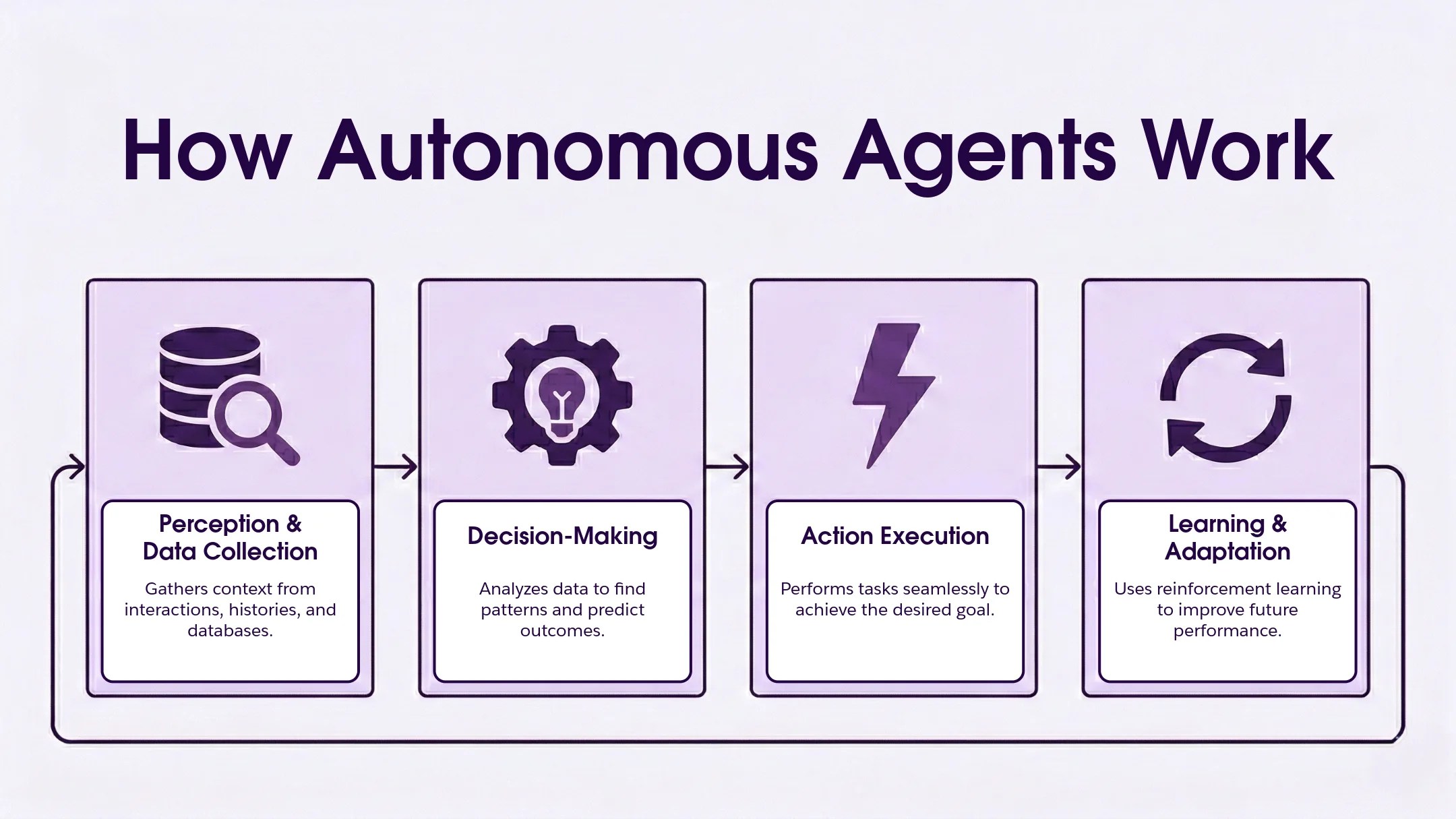
To keep agents effective, you must establish a closed-loop feedback system. Monitor execution logs for drift, latency spikes, or compliance violations. When an agent deviates, capture the error pattern and feed it back into the prompt engineering or retrieval logic. This continuous refinement cycle is what separates fragile demos from reliable digital workers.
Implement regular audit checkpoints. Just as a financial audit ensures regulatory compliance, technical audits verify that agent actions align with business policies. Use these reviews to update knowledge bases and adjust autonomy thresholds, ensuring your agents remain precise, secure, and aligned with evolving operational needs.
No comments yet. Be the first to share your thoughts!