
What makes an agent truly autonomous
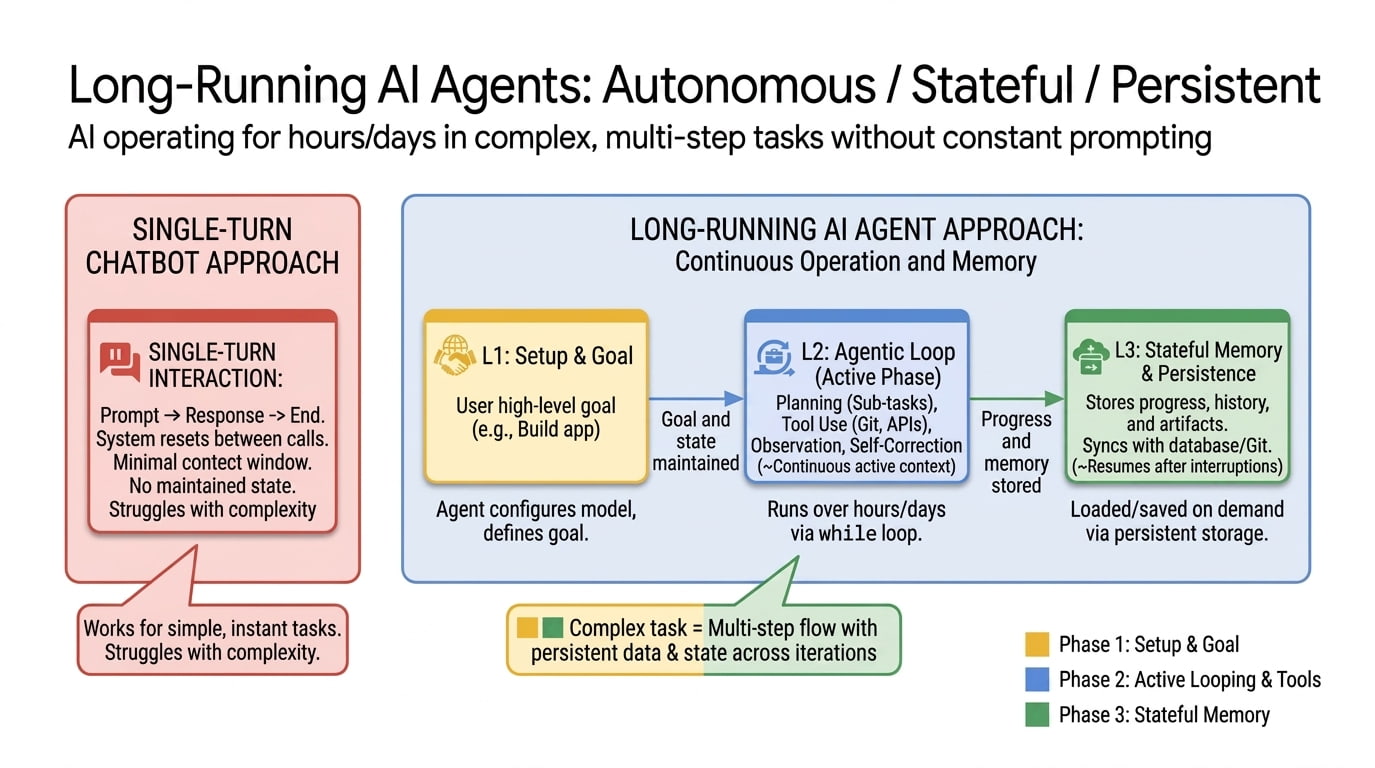
Autonomous AI agents represent a shift from passive response to active execution. Unlike standard generative AI models that wait for a prompt and return text, or basic automation scripts that follow rigid, linear rules, an autonomous agent possesses the capacity to reason, plan, and act independently to achieve a goal.
The defining characteristic of a truly autonomous agent is its ability to self-heal. In enterprise workflows, failures are inevitable: an API endpoint may timeout, a data format might shift, or a permission check could fail. Standard automation stops and alerts a human. An autonomous agent evaluates the error, adjusts its strategy, and attempts a recovery path without human intervention.
This distinction is critical for enterprise adoption. While basic automation handles high-volume, predictable tasks, autonomous agents manage complex, variable processes. They iteratively evaluate outcomes, adapt their plans, and pursue goals with minimal oversight, effectively closing the loop between decision-making and action.
Designing self-healing workflow loops
Basic automation fails when the environment changes; a self-healing workflow loop treats failures as data points rather than stop signs. Instead of escalating errors to human operators, these systems use a continuous cycle of detection, diagnosis, and correction to maintain operational integrity. This approach transforms fragile scripts into resilient enterprise-grade workflows that adapt to transient glitches, API rate limits, or unexpected data formats.
1. Detect anomalies in real-time
The loop begins with continuous monitoring. Agents must distinguish between expected system noise and genuine failures. This involves setting up health checks that verify not just service availability, but also data integrity and latency thresholds. When an error occurs, the agent logs the specific exception, the surrounding context, and the state of the workflow at that exact moment.
2. Diagnose the root cause
Once an anomaly is detected, the agent analyzes the error signature to determine the root cause. It compares the current failure against a knowledge base of known issues. For example, if a database query times out, the agent checks if it is a transient network blip or a structural lock contention. This step often involves querying internal logs or external documentation to understand the "why" behind the failure.
3. Execute corrective actions
With a diagnosis in hand, the agent selects a remediation strategy from its playbook. Common actions include retrying the operation with exponential backoff, switching to a fallback service, or adjusting parameters to bypass the bottleneck. The agent executes the fix and verifies that the workflow has returned to a healthy state before proceeding.
async function resilientWorkflow(stepData) {
  let attempts = 0;
  const maxRetries = 3;

  while (attempts < maxRetries) {
    try {
      await executeStep(stepData);
      return { status: 'success', attempts };
    } catch (error) {
      attempts++;
      if (attempts === maxRetries) {
        // Escalate only after all self-healing attempts fail
        await escalateToHuman(error, stepData);
      } else {
        // Diagnose and wait before retrying
        await diagnoseAndBackoff(error, attempts);
      }
    }
  }
}
Comparing agent frameworks and tools
Choosing the right stack for self-healing workflows requires looking beyond basic orchestration. Most platforms handle happy paths; few manage failure states with the autonomy needed for enterprise reliability. We compare four leading options based on their ability to detect, diagnose, and recover from errors without human intervention.
| Platform | Autonomy Level | Self-Healing Capability | Enterprise Readiness |
|---|---|---|---|
| LangGraph | High | Automatic retry loops with state restoration | Yes, via LangSmith |
| AutoGen | Medium | Multi-agent debate to resolve conflicts | Limited, requires custom setup |
| CrewAI | Medium | Role-based fallback mechanisms | Yes, via Azure integration |
| Microsoft Copilot Studio | Low | Rule-based fallback to human agent | Yes, native Microsoft 365 |
LangGraph offers the most robust self-healing architecture by treating workflows as state machines. When an LLM call fails or produces invalid JSON, LangGraph can automatically rewind the state graph and retry the specific node, preserving context. This is critical for long-running workflows where losing intermediate steps means restarting the entire process.
AutoGen takes a different approach by using multi-agent conversations to resolve errors. If one agent fails to execute a code snippet or retrieve data, other agents in the group can analyze the error message and suggest a corrected approach. This collaborative debugging is powerful but introduces latency, making it less suitable for real-time transactional systems.
CrewAI simplifies error handling through role-based fallbacks. If a specific agent (e.g., a "Researcher") encounters a blockage, the framework can delegate the task to a more generalist agent or trigger a predefined recovery protocol. This is easier to implement than LangGraph but offers less granular control over the recovery logic.
Microsoft Copilot Studio relies on deterministic fallbacks. If an AI-generated response fails confidence thresholds, it routes to a human agent or a predefined FAQ. While reliable, this is not true self-healing; it shifts the burden of error resolution to humans, which contradicts the goal of autonomous, self-healing enterprise workflows.
Implementing agents in enterprise systems
Autonomous AI Agents works best as a clear sequence: define the constraint, compare the realistic options, test the tradeoff, and choose the path with the fewest hidden costs. That order keeps the advice usable instead of decorative. After each step, pause long enough to check whether the recommendation still fits the reader's actual situation. If it depends on perfect timing, unusual access, or a best-case budget, include a simpler fallback.
Common questions about autonomous agents
Autonomous AI agents are advanced systems that operate independently to process data, make decisions, and execute tasks without continuous human supervision. Unlike traditional automation scripts that follow rigid, pre-defined rules, these agents use machine learning to adapt to changing conditions and resolve issues on their own.
The primary differentiator is the "self-healing" capability. While standard automation fails when it encounters an unexpected error, a self-healing agent detects the anomaly, diagnoses the root cause, and executes a recovery workflow to restore the system state. This reduces operational downtime and minimizes the need for manual IT intervention.
What are the four types of AI agents?
AI agents are generally categorized by their level of autonomy and decision-making complexity:
- Simple Reflex Agents: React to current percepts based on condition-action rules without maintaining internal state.
- Model-Based Reflex Agents: Maintain an internal model of the world to handle partially observable environments.
- Goal-Based Agents: Use goal information to decide actions, searching for sequences that achieve a desired outcome.
- Utility-Based Agents: Evaluate actions based on a utility function to maximize performance, allowing for nuanced trade-offs between competing objectives.
Is ChatGPT an autonomous agent?
Standard ChatGPT is not an autonomous agent; it is a large language model (LLM) that generates text responses based on prompts. It lacks the ability to independently execute external tasks or modify systems. However, when integrated with tools and APIs via frameworks like AutoGen or CrewAI, the LLM acts as the "brain" of an autonomous agent, directing other tools to perform actions such as sending emails or updating databases.
Who are the big 4 AI agents?
There is no single "big 4" list, as the market is fragmented across specialized platforms. However, the most prominent enterprise-grade autonomous agent ecosystems include:
- Microsoft Copilot Agents: Integrated into the Microsoft 365 ecosystem for enterprise workflows.
- Salesforce Agentforce: Designed specifically for CRM automation and customer service interactions.
- Amazon Q Business: Focused on enterprise knowledge retrieval and document processing.
- OpenAI Assistants API: A foundational framework used by many developers to build custom agent behaviors.
No comments yet. Be the first to share your thoughts!