
The shift to autonomous agents
By 2026, enterprise AI has moved beyond conversational interfaces to autonomous execution. Organizations are no longer just asking questions; they are deploying agents that plan, act, and verify outcomes without constant human oversight. This transition marks a fundamental change in how software delivers value, shifting from a tool that assists to a workforce that operates.
The scale of this adoption is significant. According to Gartner, 40% of enterprise applications will feature task-specific AI agents by the end of 2026, up from less than 5% in 2025 [1]. This rapid uptake reflects a broader recognition that autonomous agents can handle complex, multi-step workflows more reliably than traditional automation scripts.
This shift redefines the cost structure of enterprise software. Instead of viewing AI as a line-item subscription, companies are evaluating it as a capital investment with measurable return on investment. Understanding the financial implications of this transition is essential for leadership teams planning their technology budgets for the coming year.
[1] https://www.generative.inc/agentic-ai-in-2026-how-ai-went-from-chatting-to-doing
Calculate your automation ROI
Autonomous AI agents shift enterprise spending from variable labor costs to fixed implementation fees. Understanding this transition requires a clear view of your current expenditure and the efficiency gains these agents deliver.
Enter your current monthly labor costs, the expected efficiency gain percentage, and the one-time implementation fee. The calculator projects your monthly net savings and the timeline to recoup your initial investment.
Cost drivers for enterprise agents
The final price tag of an autonomous AI agent is rarely a flat licensing fee. It is a variable construct built from four distinct cost pillars: compute, API calls, integration complexity, and ongoing maintenance. Understanding these drivers is essential for accurate budgeting, as the calculator’s output reflects these real-world operational expenses rather than theoretical benchmarks.
Compute and API overhead
The most immediate cost comes from the tokens required to process each step of an agent’s workflow. Unlike static chatbots that wait for user input, autonomous agents execute multi-step reasoning loops. Each loop consumes input tokens (context) and output tokens (reasoning + action). High-frequency tasks or complex reasoning models drive this cost up significantly, turning what looks like a simple query into a substantial monthly compute bill.
Integration and orchestration
Agents do not exist in a vacuum; they must connect to existing enterprise systems. This integration layer often requires custom API connectors, middleware, and security gateways. As CogitX notes, autonomous agents operate independently once given an objective, which means they need robust, secure pathways to internal databases and CRMs. Building and maintaining these connections adds a fixed infrastructure cost that scales with the number of integrated systems.
Maintenance and monitoring
Autonomous delivery models handle workflow execution within defined boundaries, but those boundaries require constant supervision. V2Soft highlights that while agents reduce manual management, they introduce new maintenance needs. This includes monitoring for "hallucinations," updating system prompts as business logic changes, and retraining models on new data. These operational costs are recurring and often underestimated in initial ROI projections.
Comparing cost structures
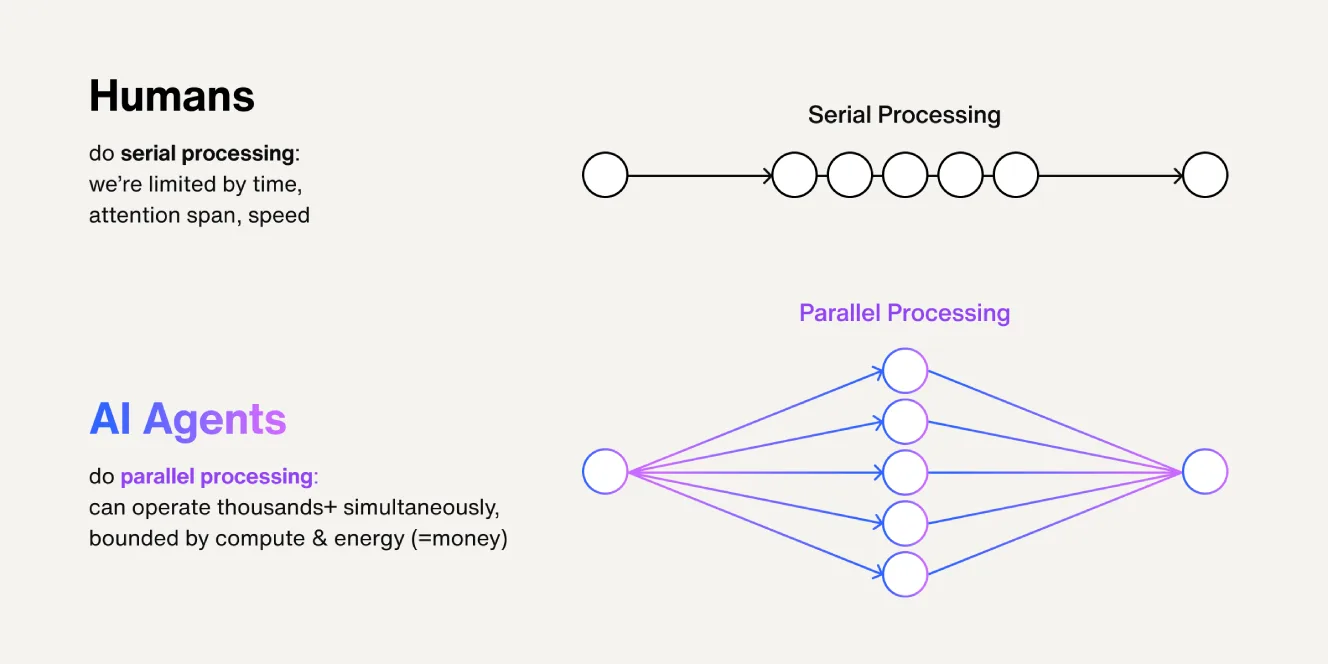
The cost profile changes drastically depending on the agent's architecture. Single-task agents have lower integration costs but may require more compute per specific task. Multi-agent systems distribute the workload, potentially lowering per-task API costs, but they introduce higher orchestration and maintenance complexity.
| Feature | Single-Task Agent | Multi-Agent System |
|---|---|---|
| API Calls | Higher per task | Lower per task (distributed) |
| Integration | Simple (1-2 systems) | Complex (orchestration layer) |
| Maintenance | Low | High (monitoring coordination) |
| Compute | Predictable | Variable (dynamic routing) |
Production readiness and failure rates
The gap between a successful demo and a reliable production system is where most autonomous AI agent projects lose their value. Research indicates that 77% of autonomous AI agents fail to reach production, meaning only 23% of initiated projects actually deliver the cost savings or efficiency gains promised in the planning phase. This high failure rate is not a sign that the technology is immature, but rather that it requires rigorous structural discipline to operate safely at scale.
Agents often fail because they are designed to be "super agents" capable of handling broad, undefined tasks. In practice, autonomous systems perform best when they are strictly bounded. Agents that operate within clear, narrow lanes—performing specific, repetitive workflows with defined guardrails—have a significantly higher likelihood of stable deployment. When agents are given too much autonomy without precise constraints, they drift into unpredictable behaviors that break downstream processes.
To realize the ROI calculated in the previous section, organizations must treat production readiness as a distinct engineering phase rather than an afterthought. This involves implementing strict input validation, monitoring for context drift, and establishing fallback protocols for when an agent encounters an edge case outside its training data. Without these safeguards, the cost of manual intervention to correct agent errors often exceeds the savings the agent was meant to generate.

Frequently asked questions about autonomous AI agent implementation
Enterprise leaders often hesitate before deploying autonomous AI agents due to uncertainty around timelines, security, and operational models. These concerns are valid, but the data from 2026 shows that successful implementations follow strict guardrails. Below are answers to the most common questions about integrating autonomous agents into enterprise workflows.
How long does it take to deploy autonomous AI agents?
Deployment timelines vary significantly based on complexity and integration depth. According to Gartner, 40% of enterprise applications will feature task-specific AI agents by the end of 2026, up from less than 5% in 2025, indicating rapid adoption. However, the journey from proof-of-concept to production is often longer than expected. Research indicates that only 23% of autonomous AI agent projects reach full production, primarily due to the "demo-to-production gap." A typical enterprise deployment for a single, well-defined workflow takes 3-6 months, including integration, testing, and security auditing.
Are autonomous AI agents secure?
Security is the primary concern for any enterprise adopting autonomous software. Agents operate independently, which means they require robust access controls and audit trails. The key to security is designing agents to "stay in their lanes," as noted by CIO. This means limiting their permissions to specific tasks and data sets, rather than giving them broad administrative access. Regular security audits and human-in-the-loop checkpoints for high-stakes decisions are essential to prevent unauthorized actions or data breaches.
What is the difference between AI copilots and autonomous agents?
The distinction lies in the level of autonomy and human oversight. AI copilots, or assistants, operate under continuous human direction, offering suggestions and executing commands as given. They are tools that augment human decision-making. Autonomous agents, on the other hand, plan and execute actions independently once given an objective. They do not require step-by-step instructions for every action. While copilots are like a co-pilot in a plane, autonomous agents are more like the autopilot system, handling routine operations and making decisions within predefined boundaries.
No comments yet. Be the first to share your thoughts!