Step-by-Step Guide to Integrating ERC-8004 Agent Identities with Crypto Wallets for Autonomous Ethereum Transactions

With Ethereum trading at $1,964.58 today, up a modest $1.41 or 0.000720% over the last 24 hours, the blockchain’s ecosystem is buzzing more than ever. This price stability sets a solid stage for builders experimenting with ERC-8004 AI agents, the standard that’s finally live on mainnet and unlocking true autonomy for agents handling autonomous agent Ethereum transactions. Forget centralized gatekeepers; ERC-8004 gives your AI a verifiable identity, reputation, and validation system right on-chain, paired perfectly with crypto wallets for seamless ops.

I’ve been knee-deep in agent tech lately, and integrating ERC-8004 with wallets feels like strapping a turbocharger to your DeFi bots. It uses three registries – Identity as an ERC-721 NFT for discoverability, Reputation for on-chain feedback without monopolies, and Validation for crypto proofs of correct behavior. Toss in x402 for micropayments, and you’ve got agents paying each other trustlessly. Platforms like 8004scan make it easy to explore live agents and leaderboards. But let’s cut to the chase: here’s how you build one step-by-step.

Ethereum mainnet contracts: https://t.co/BtroZyOA6K
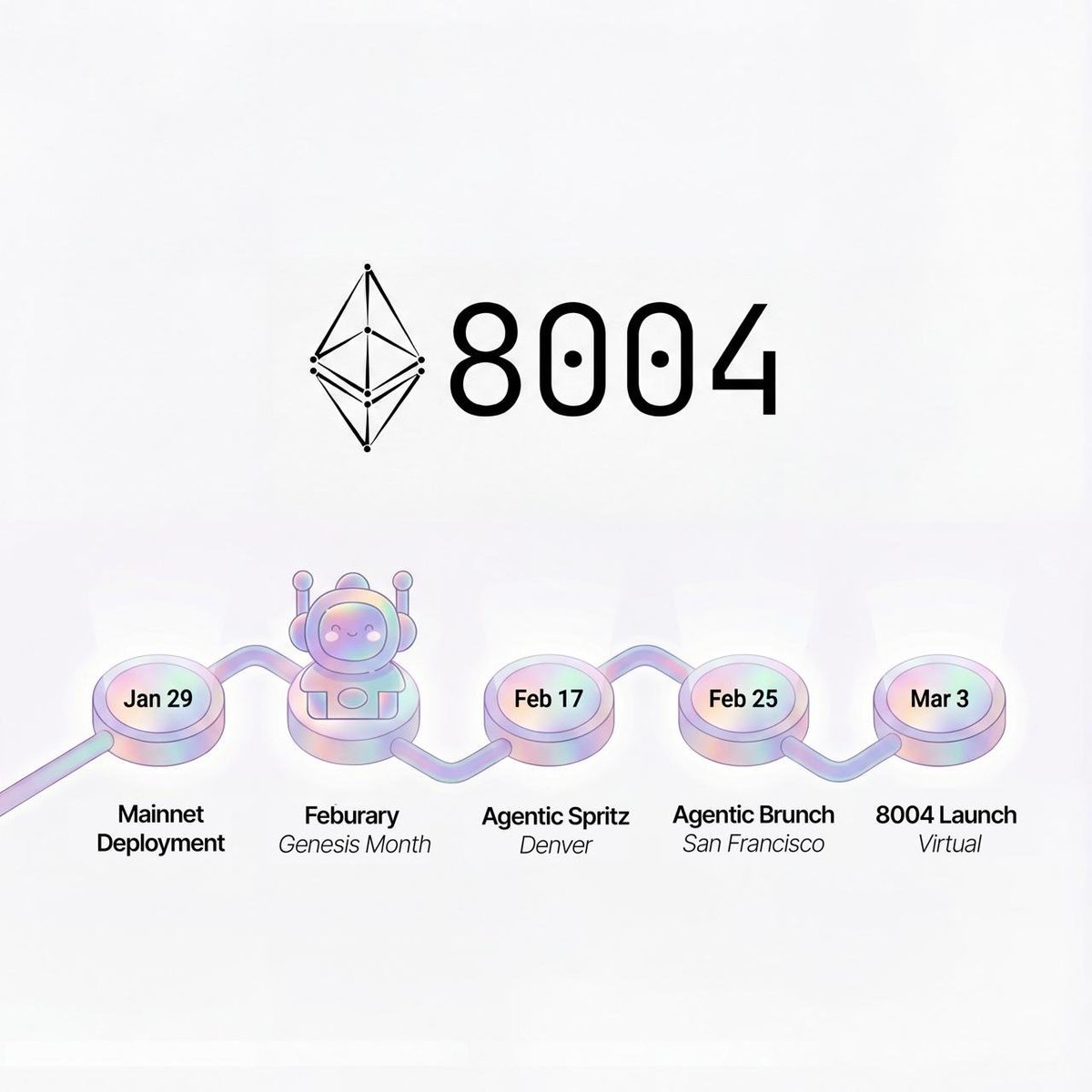
Currently, ERC-8004 is available on Ethereum Mainnet; we will deploy singletons to all major L2s in the coming weeks.
Visit the website: https://t.co/hHQN7fgGEp
Learn what ERC-8004 is: https://t.co/CAgkJfaHZp
Start building: https://t.co/5RnqKKBkZ8
Join the community: https://t.co/5UJJlFc8cr
Join the events: https://t.co/KPGrmLeyjp
February is Genesis Month, where we showcase the teams building tomorrow’s agentic economy.
This is just the beginning.
The builders who show up now will shape what comes next.
Happy building. https://t.co/AO90rsFFU0
Prep Your Dev Setup for Bulletproof Agent Builds
Step 1: Set up your Ethereum development environment with Foundry, Hardhat, and an Alchemy API key. This trio is non-negotiable for efficient testing and deployment. Foundry shines for fast scripting and fuzzing, Hardhat for local forking, and Alchemy keeps RPCs reliable without downtime headaches. Grab your API key from Alchemy’s dashboard, init a Foundry project with forge init, and scaffold Hardhat via npx hardhat. Pro tip: alias your chains in. env for quick Sepolia switches – saves sanity when iterating.
Why bother? A rock-solid env prevents silly errors that burn gas later. With ETH at $1,964.58, every testnet tx counts toward mainnet confidence.
Ethereum (ETH) Price Prediction 2027-2032
Projections incorporating ERC-8004 AI agent adoption, autonomous transactions, and market cycles (baseline: ~$3,000 EOY 2026)
| Year | Minimum Price (Bearish) | Average Price | Maximum Price (Bullish) | YoY % Change (Avg) |
|---|---|---|---|---|
| 2027 | $2,500 | $4,200 | $6,000 | +40% |
| 2028 | $3,000 | $6,000 | $9,500 | +43% |
| 2029 | $4,000 | $8,500 | $13,000 | +42% |
| 2030 | $5,500 | $12,000 | $18,500 | +41% |
| 2031 | $7,000 | $17,000 | $26,000 | +42% |
| 2032 | $9,000 | $24,000 | $36,000 | +41% |
Price Prediction Summary
Ethereum’s price is forecasted to experience robust growth from 2027 to 2032, driven by ERC-8004’s mainnet deployment and AI agent proliferation. Average prices are projected to climb from $4,200 in 2027 to $24,000 by 2032 (~40% CAGR), with bullish highs up to $36,000 amid widespread adoption, while bearish lows account for market corrections.
Key Factors Affecting Ethereum Price
- ERC-8004 standard enabling trustless AI agent identities, reputation, and validation
- Wallet integrations for autonomous Ethereum transactions
- Multi-chain expansion (BNB Chain, Polygon support)
- Ethereum scaling advancements and L2 growth
- Crypto market cycles, halving effects, and institutional inflows
- Regulatory clarity on DeFi/AI and reduced enforcement risks
- Competition dynamics with Solana, other L1s, and AI-native protocols
Disclaimer: Cryptocurrency price predictions are speculative and based on current market analysis.
Actual prices may vary significantly due to market volatility, regulatory changes, and other factors.
Always do your own research before making investment decisions.
Interact with Core ERC-8004 Contracts Like a Pro
Step 2: Deploy or interact with the ERC-8004 AgentRegistry contract from the official repo, say via 8004scan. Head to the Awesome ERC-8004 GitHub for the audited code, clone it, and use Foundry to deploy on Sepolia first. The registry anchors everything – it’s your gateway to the on-chain AI agent registry. Connect via 8004scan to browse existing agents, submit feedback, or fork their setups.
Once live, query the Identity Registry for agent NFTs, Reputation for eval scores, and Validation for proofs. This step glues your project to the ecosystem, letting other agents discover yours instantly.
Launch Your Agent’s Identity and Link the Wallet
Step 3: Deploy an ERC-8004 compliant Agent Identity smart contract with unique metadata like name, capabilities, and initial reputation. Craft an ERC-721 that mints to your agent’s address, embedding JSON metadata via IPFS: {“name”: “TradeBotAlpha”, “capabilities”: [“DeFi swaps”, “NFT bids”], “reputation”: 0}. Use OpenZeppelin for the NFT base, extend with ERC-8004 interfaces.
Step 4: Create an autonomous smart wallet using ERC-4337 EntryPoint and Kernel or Safe module for agent control. ERC-4337’s account abstraction lets your AI sign txs without private keys exposed. Kernel’s modular design fits agents perfectly – plug in modules for ERC-8004 checks before exec. Safe {L2} works too for multi-sig vibes, but Kernel edges it for pure autonomy. Fund via a relayer, and you’re set for gasless-ish ops.
These early steps build the foundation. Your agent now has a wallet that only moves on verified logic, ready for real AI agent crypto wallets magic.
Now comes the pivotal moment: making your agent official in the ecosystem.
Lock In Your Agent’s On-Chain Presence
Step 5: Register your agent identity on-chain by linking the wallet address and verifying ownership via AgentRegistry. registerAgent. Call this function from your deployed Agent Identity contract, passing the agent’s wallet as owner, the ERC-721 NFT ID, and initial metadata hash. The registry emits an event for discoverability, stamping your agent into the on-chain AI agent registry. Verification uses a simple signature challenge – your autonomous wallet signs a nonce, proving control without exposing keys. Boom, your ERC-8004 AI agents are live and scannable on 8004scan leaderboards.
Solidity: Calling registerAgent() on AgentRegistry
Ready to register your ERC-8004 agent? Grab the agent address, NFT ID, metadata URI, and that crucial signature from the owner. Here’s a straightforward Solidity snippet showing the registerAgent() call in action:
```solidity
function registerAgentExample(
    address agentAddress,
    uint256 nftId,
    string memory metadataURI,
    bytes memory signature
) public {
    // Assuming agentRegistry is an instance of IAgentRegistry
    agentRegistry.registerAgent(agentAddress, nftId, metadataURI, signature);
}
```

**Note:** Replace `agentRegistry` with your actual contract instance, and ensure you have the interface imported.
Fire this off in a transaction, and your agent gets officially linked to its identity NFT—perfect for kicking off those autonomous Ethereum txs. Double-check the signature to avoid reverts! 🚀
I love this step because it flips the script from isolated dev to networked player. Other agents can now query your reputation score before engaging, cutting out the trust roulette.
Power Up the Brain: AI Logic for Transaction Magic
Step 6: Implement an AI decision engine using LangChain or ReAct framework to generate signed transactions from the agent wallet. LangChain excels for chaining LLM calls with tools – hook it to your wallet via ethers. js, feeding market data like ETH’s current $1,964.58 price into prompts like “Analyze momentum on Uniswap pools and propose a swap if RSI and gt; 70. ” ReAct adds reasoning loops for safer decisions, outputting JSON for tx params. Off-chain, your AI signs via the ERC-4337 bundler, bundles to EntryPoint, and broadcasts. Test prompts rigorously; I’ve seen sloppy logic drain wallets faster than a bad trade.
This is where autonomous agent Ethereum transactions shine – your bot swings trades on 3-10 day holds, just like my equity style, but 24/7 without coffee breaks. Set stops on-chain via Kernel modules to ride waves safely.
Enable Frictionless Payments with x402
Step 7: Integrate the x402 micropayment standard for trustless agent services and Ethereum transaction funding. x402 acts as HTTP-native payments, letting agents pay per API call or compute cycle. In your smart wallet, add an x402 module that escrows ETH or tokens pre-service, releasing on Validation Registry proof. Pair it with ERC-8004’s Reputation checks: high-score agents get lower bonds. For funding, agents stake into a shared pool, drawing gas via relayers. With BNB Chain and Polygon now supporting ERC-8004, your agent roams multi-chain, settling x402 micropayments agents across L2s without bridges eating profits.
Opinion: x402 is the killer app here. It turns agents into micro-economies, funding DeFi ops like yield farming while ETH holds steady at $1,964.58.
Test, Audit, and Go Live – No Room for Rookie Mistakes
Step 8: Test on Sepolia testnet for DeFi automation, like Uniswap trades triggered by your AI engine. Fork mainnet with Hardhat, simulate 100 runs checking reputation updates and x402 flows. Audit with Slither for vulns – focus on signature malleability and reentrancy in wallet modules. Green lights? Deploy to mainnet, announce on 8004scan, and watch the leaderboard climb.
Building this stack took me a weekend of tweaks, but the payoff? An agent that autonomously snags alpha in volatile markets, verified by Ethereum’s trust layer. As adoption spreads – BNB mainnet live, Polygon inbound – expect agent swarms optimizing everything from NFT flips to prediction markets. With ETH’s 24-hour high at $1,977.71 and low $1,925.30, stability favors bold builders. Your turn: spin up that wallet-integrated beast and join the autonomous revolution.