
What defines an AI agent in 2026
The era of simple prompts is over. We are witnessing the agent leap, where AI orchestrates complex, end-to-end workflows semi-autonomously. While earlier models acted as passive chatbots that responded to queries, AI agents 2026 are defined by their ability to execute tasks and use tools on your behalf.
An AI agent is a system that combines advanced AI intelligence with the capability to interact with external environments. This means the software doesn't just generate text; it reads emails, queries databases, updates CRM records, and triggers API calls to complete a goal without constant human intervention. The core shift is from generation to action.
For enterprise developers, this distinction changes how we build and trust software. We no longer evaluate models solely on accuracy or latency. We evaluate them on reliability, tool usage precision, and the ability to recover from errors in a multi-step workflow. The agent is not a writer; it is a worker.
Compare frameworks for AI agents 2026
Choosing the right architecture depends on whether you need strict state control, autonomous multi-agent negotiation, or rapid prototyping. The following comparison highlights LangGraph, AutoGen, and CrewAI to help you match the tool to your specific engineering requirements.
| Framework | Complexity | Best Use Case | Enterprise Support |
|---|---|---|---|
| LangGraph | High | Deterministic, stateful workflows | Strong (LangChain ecosystem) |
| AutoGen | Medium | Multi-agent conversation patterns | Moderate (Microsoft backing) |
| CrewAI | Low | Role-based task delegation | Emerging (Open source) |
LangGraph: Stateful Control
LangGraph is built for developers who require explicit control over the execution graph. It treats agent interactions as a directed graph, allowing you to define precise loops, conditional branches, and human-in-the-loop checkpoints. This makes it ideal for complex enterprise workflows where reproducibility and debugging are critical.
The learning curve is steeper because you must manage state transitions manually. However, this transparency ensures that when a multi-step process fails, you can pinpoint the exact node responsible. It is the preferred choice when your AI agents 2026 strategy demands deterministic outcomes rather than probabilistic chatter.
AutoGen: Multi-Agent Conversation
AutoGen focuses on conversational patterns between multiple agents. Instead of a predefined graph, agents negotiate tasks and share context through messages. This approach is powerful for research, coding assistance, or scenarios where the solution path is not known in advance.
While flexible, AutoGen can become difficult to debug due to the dynamic nature of conversations. It is best suited for applications where the primary value is the synthesis of diverse perspectives rather than a linear, repeatable process. Microsoft’s backing provides robust tooling, but the lack of strict state management can be a liability in regulated industries.
CrewAI: Role-Based Orchestration
CrewAI simplifies agent design by assigning specific roles and goals to each agent. It abstracts away the low-level graph management, allowing you to define a "crew" where members delegate tasks to one another. This is the fastest path to a working prototype for role-based automation.
CrewAI is less suitable for highly complex, state-heavy workflows where fine-grained control is necessary. It excels in modular task execution, such as content generation pipelines or data processing chains, where agents operate semi-independently. For teams prioritizing speed of development over architectural rigidity, CrewAI offers the most accessible entry point.
Selecting Your Architecture
The decision comes down to control versus convenience. Use LangGraph if you are building mission-critical systems that require auditability and strict state management. Choose AutoGen if your problem space benefits from dynamic, multi-agent collaboration and negotiation. Opt for CrewAI if you need to quickly deploy role-based agents for structured task delegation.

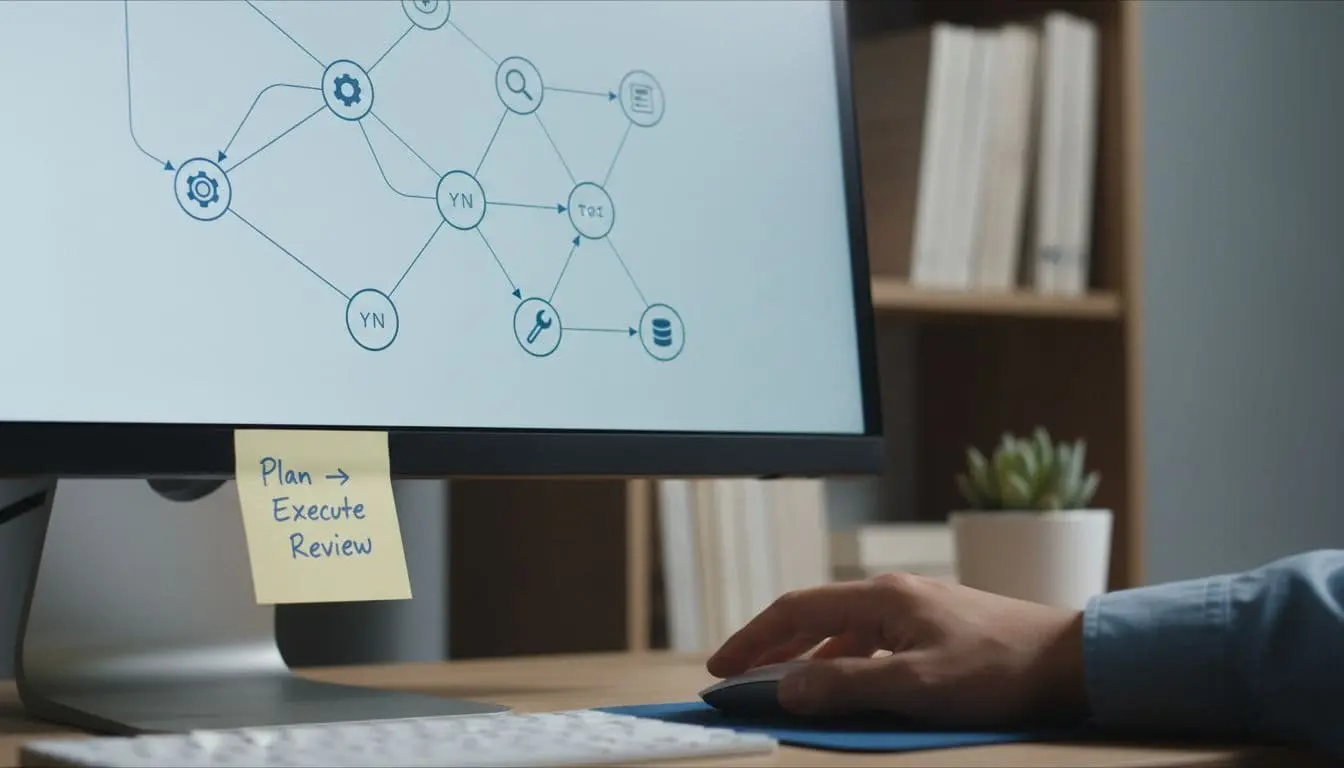
Orchestrate multi-agent systems for enterprise workflows
Single agents struggle with tasks that require specialized knowledge across different domains. By 2026, the standard for complex enterprise operations is multi-agent orchestration. This approach breaks down large workflows into specialized sub-tasks, assigning each to an agent optimized for that specific function. The result is a system that handles end-to-end processes with greater accuracy and reliability than any single model could achieve alone.
Define agent roles and communication protocols
Before writing code, map out the distinct roles each agent will play. In a typical enterprise workflow, you might have a planner agent that breaks down user requests, a research agent that fetches real-time data, and an execution agent that performs the final action. Clear role definition prevents agents from duplicating efforts or entering conflicting loops. Establish a strict communication protocol, such as JSON schemas or structured message passing, so agents can share context without ambiguity.
Implement shared state and memory
Multi-agent systems require a shared context to maintain coherence across steps. Implement a central memory store or state management layer where agents can read previous outputs and write new findings. This shared state acts as the system's working memory, ensuring that the research agent's findings are immediately available to the execution agent. Without this persistent context, each agent would operate in isolation, leading to fragmented and inconsistent results.
Add deterministic guardrails
As outlined in recent trends for AI agents 2026, deterministic guardrails are essential for enterprise readiness. These guardrails enforce business logic and safety constraints at the orchestration level, not just within individual models. Use middleware to validate outputs before they pass between agents. For example, if the research agent returns unverified data, the guardrail can reject it before the execution agent attempts to act on it. This layer of control is critical for maintaining compliance and preventing hallucinations from propagating through the workflow.
Orchestrate execution with code
Use an orchestration framework to manage the lifecycle of your agents. Below is a conceptual example of how to structure a multi-agent workflow using a Python-based orchestrator. This snippet demonstrates defining agents, setting up their dependencies, and triggering the execution chain.
from orchestration import Agent, Workflow

# Define specialized agents
researcher = Agent(name="researcher", model="gpt-4o", role="data_fetcher")
analyst = Agent(name="analyst", model="claude-3.5", role="data_analyzer")
executor = Agent(name="executor", model="gpt-4o-mini", role="action_performer")

# Create workflow
workflow = Workflow(name="enterprise_report")
workflow.add_agent(researcher)
workflow.add_agent(analyst)
workflow.add_agent(executor)

# Define dependencies
workflow.add_dependency(analyst, researcher)
workflow.add_dependency(executor, analyst)

# Execute
result = workflow.run(input="Analyze Q3 sales data")
This structure ensures that each agent completes its task before the next one begins, creating a reliable pipeline for complex operations.
Ensuring safety and guardrails
Enterprise adoption of AI agents 2026 hinges on deterministic guardrails. Without them, agents drift into hallucinations or execute unauthorized actions. The shift from probabilistic outputs to constrained behaviors requires explicit context engineering and strict policy enforcement at the application layer.
Context Engineering
Context engineering limits the agent’s operating window. Instead of feeding raw data, you structure inputs to exclude irrelevant or dangerous variables. This reduces the surface area for errors. Agents trained on narrow, verified contexts make fewer assumptions and produce more predictable outcomes.
Deterministic Guardrails
Guardrails act as real-time filters. They intercept agent outputs before they reach users or downstream systems. These filters check for policy violations, sensitive data leaks, or logical inconsistencies. If a request falls outside safe parameters, the agent halts or redirects. This layer ensures compliance without manual oversight.
Action Authorization
Agents often need to trigger external tools. Authorization protocols define which actions are permissible. For example, an agent might read customer data but never delete it. By separating read and write permissions, you prevent catastrophic errors. This principle of least privilege is standard in enterprise security and applies directly to agentic workflows.
Implementation Strategy
Start with a clear policy definition. Map out every possible action an agent might take. Then, implement filters at each stage: input validation, context construction, and output verification. This multi-layered approach creates a robust safety net. It allows agents to operate efficiently while maintaining strict control over their behavior.
Checklist for enterprise adoption
Before deploying AI agents 2026 in production, verify that your architecture meets strict operational standards. The leap from simple prompts to semi-autonomous orchestration requires rigorous oversight. Use this checklist to evaluate security, reliability, and compliance.
- Deterministic guardrails: Implement hard constraints on agent actions to prevent unintended side effects in critical systems.
- Context engineering: Ensure the agent can maintain accurate state across long-running, multi-step workflows without hallucination.
- Audit trails: Log every decision and tool call for full traceability and regulatory compliance.
- Human-in-the-loop: Define clear escalation paths where human intervention is mandatory for high-risk operations.
Common questions about AI agents
Enterprise teams evaluating AI agents 2026 frameworks need concrete answers on cost, security, and implementation timelines. The shift from simple prompts to autonomous orchestration changes how you budget and secure your infrastructure.
No comments yet. Be the first to share your thoughts!